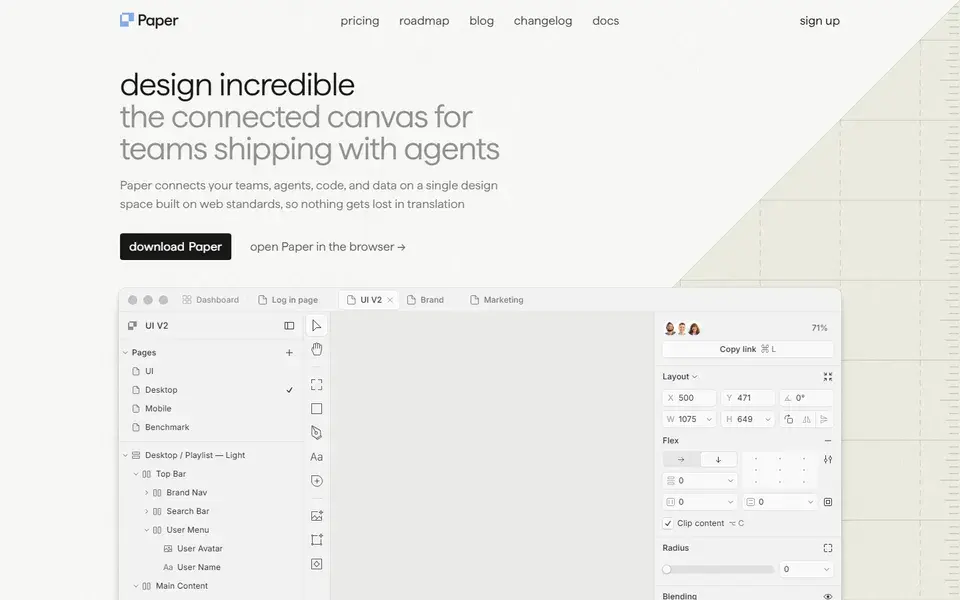
Design canvas built on HTML/CSS where IDE agents read and write layers, syncing tokens, components and real content between code and design.
design-tools
 paper.design
mygo.egoist.dev
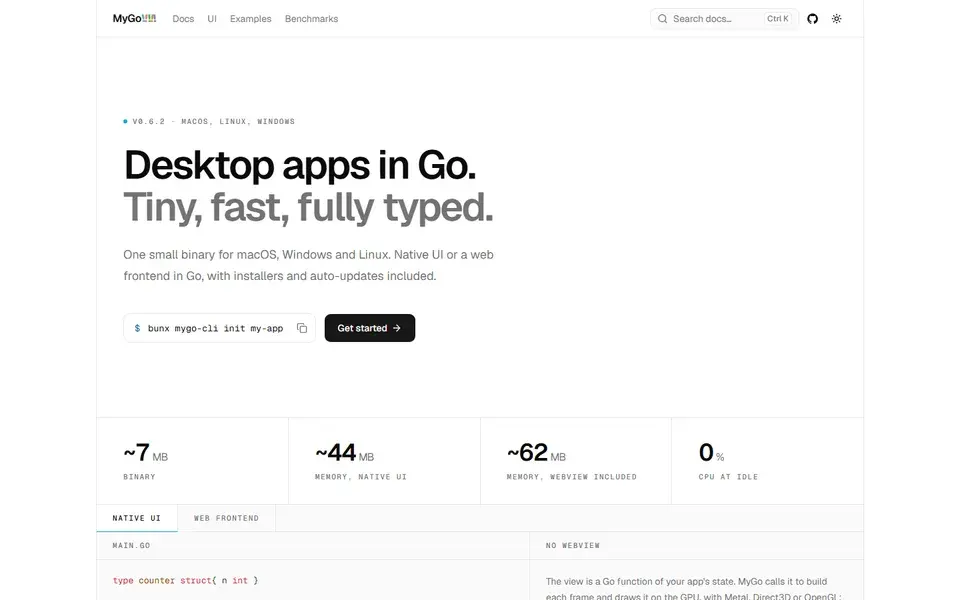
Go framework for desktop apps whose windows hold either native GPU-drawn UI or a web frontend inside the operating system's own webview.
MyGo builds desktop applications as a single few-megabyte Go binary for macOS, Linux and Windows. A window can show a web frontend in the webview the OS already provides (WKWebView, WebKitGTK, WebView2) and call bound Go services through a TypeScript client generated from the Go code, or render native UI written in Go with package ui and drawn on the GPU via Metal, Direct3D or OpenGL, with flexbox and grid layout, text editing, virtualised lists and screen-reader support.
The project is pure Go with no cgo, so any machine can cross-build for every platform. Its CLI scaffolds projects (bunx mygo-cli init, or go tool mygo dev for the native template) and handles distribution: app bundles and disk images, Windows installers, Debian packages, Arch PKGBUILDs, code signing, notarisation and signed auto-updates. The site quotes roughly 7 MB per binary, 44 MB memory for native UI and 0% idle CPU.
Design canvas built on HTML/CSS where IDE agents read and write layers, syncing tokens, components and real content between code and design.
paper.design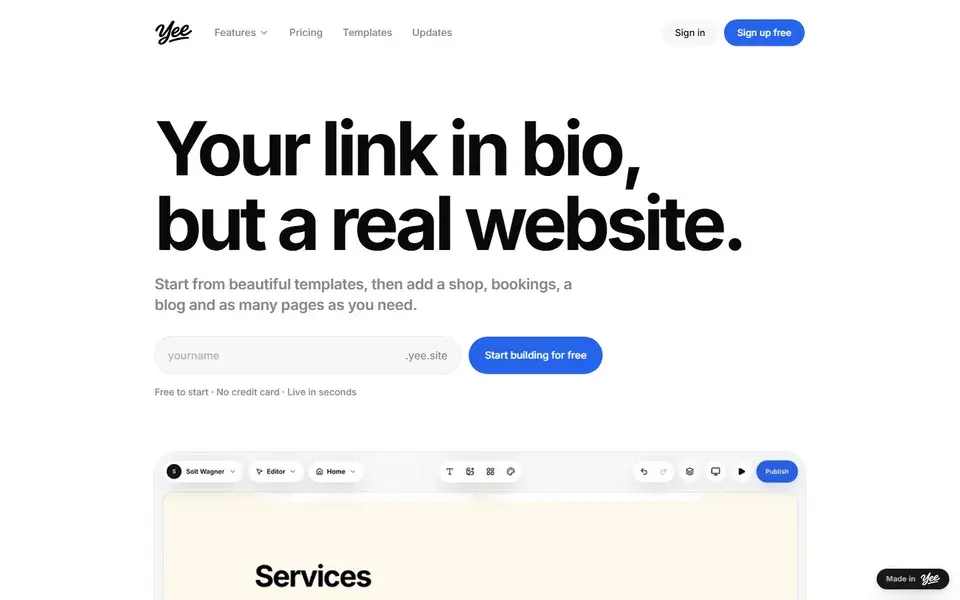
No-code site builder that turns the link-in-bio format into a real multi-page site with a shop, bookings, blog and forms.
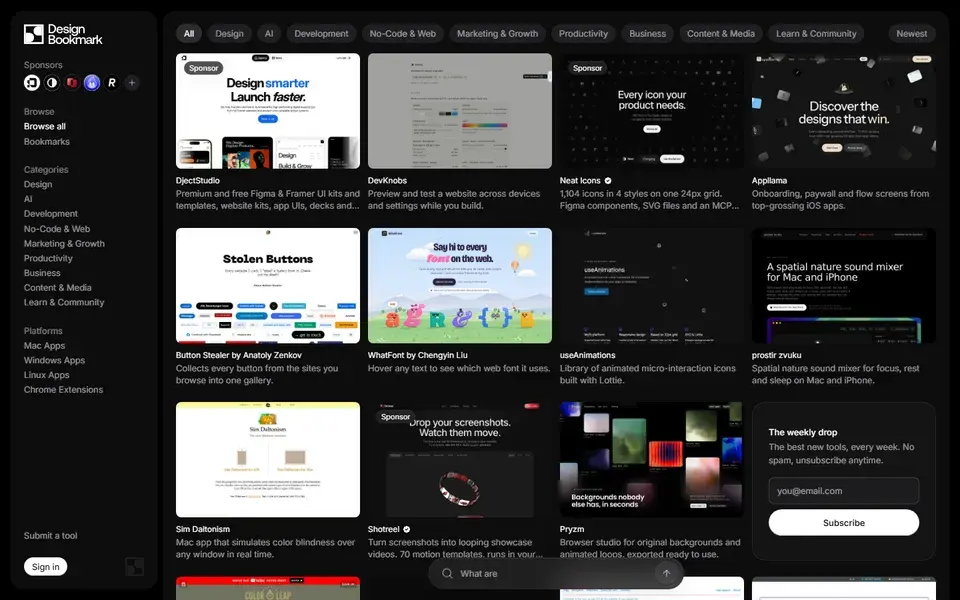
A free, carefully organized directory of 2,500+ design tools, websites, icons, fonts, mockups and resources, searchable in seconds.
 designbookmark.com